3.1 Unit 3: Boolean Algebra and Boolean Functions (14 Total Sections in Ch 3)
- Boolean operations
- Boolean expressions and equivalents
- Boolean functions
- Disjunction and conjunctive normal forms
- Simplifying Boolean expressions
- Digital logic, circuits, and gates
3.2 Module 10: Boolean Algebra and Applications
- Introduction to Boolean algebra
- Boolean expression equivalents
- Boolean functions
3.3 Lesson: Introduction to Boolean algebra 10.21.1
- After completing this lesson you should be able to evaluate a Boolean expression using Boolean operations, including expressions using parentheses.
- Boolean operations
- Boolean algebra is a set of rules and operations for working with variables whose values are either 0 or 1.
- The area of computer science concerned with designing computer circuitry is called digital logic, an indication of the vital role that logic plays in this field
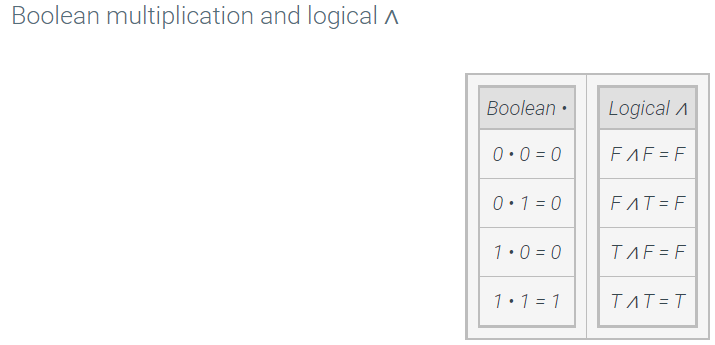
- Boolean multiplication, denoted by •, applies to two elements from {0, 1} and obeys the standard rules for multiplication.
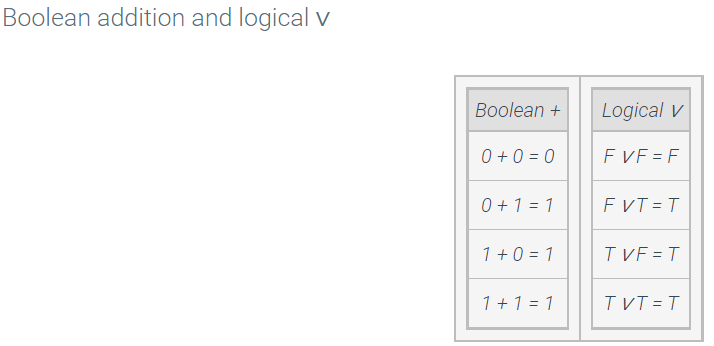
- Boolean addition, denoted by +, applies to two elements from {0, 1} and obeys the standard rules for addition, except for 1 + 1.
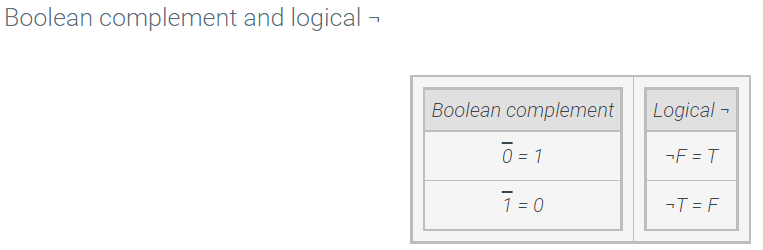
- The complement of an element, denoted with a bar symbol, reverses that element’s value.
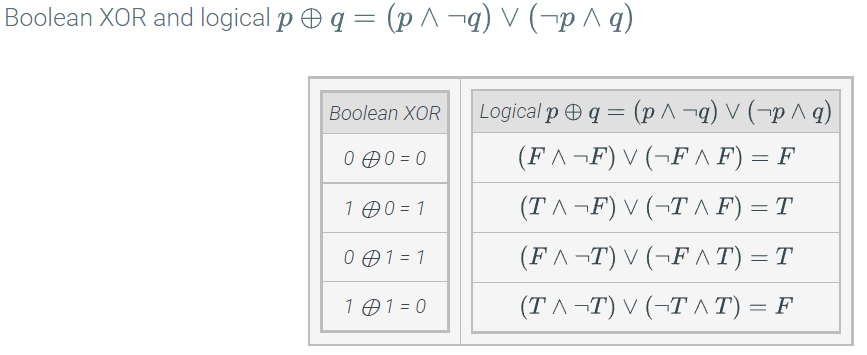
- The exclusive or or XOR operation, denoted by ⊕, is a logical operation that outputs 1 only when the inputs are different.
- Boolean expressions
- Variables that can have a value of 1 or 0 are called Boolean variables.
- Boolean expressions can be built up by applying Boolean operations to Boolean variables or the constants 1 or 0.
- Boolean algebra is, in many ways, just an expansion of the logic chapter covered in a previous unit where true (T) is now represented by 1 and false (F) is now 0.
- Compare the Boolean operators to the logical operators:Boolean OperationsLogical OperationsBoolean addition (+)Logical ∨ (OR)Boolean multiplication (⋅)Logical ∧ (AND)Boolean complement (bar symbol x¯)Logical ¬ (NOT)Boolean exclusive or (⊕)Logical ⊕ (XOR)
- Review the following results using Boolean operations
- If you are familiar with the traditional algebraic order of operations (parentheses, exponents, multiplication, and division, ending with addition and subtraction, working left to right), then the order of precedence for Boolean operators will be very familiar.
- Parentheses can override any other precedence
- Complements are calculated before addition or multiplication
- Multiplication takes precedence over addition
3.4 Lesson: Boolean expression equivalents
- After completing this lesson you should be able to simplify a Boolean expression using the laws of Boolean algebra.
- Equivalent Boolean expressions
- Two Boolean expressions are equivalent if they have the same value for every possible combination of values assigned to the variables contained in the expressions.
- Showing that two Boolean expressions are equivalent
Three methods exist to prove that two Boolean expressions are equivalent.
- Deduction – involves applying the laws of Boolean algebra to show that the two expressions are equal.
- Truth Table – involves showing that both expressions have the same truth values for all possible inputs.
- Venn diagram – involves showing that the Venn diagrams of both expressions are the same.
- Equivalent Boolean expressions have the same value for every possible combination of values given to the Boolean variables.
- In Boolean algebra the equal sign (=) is used to denote logical equivalence.
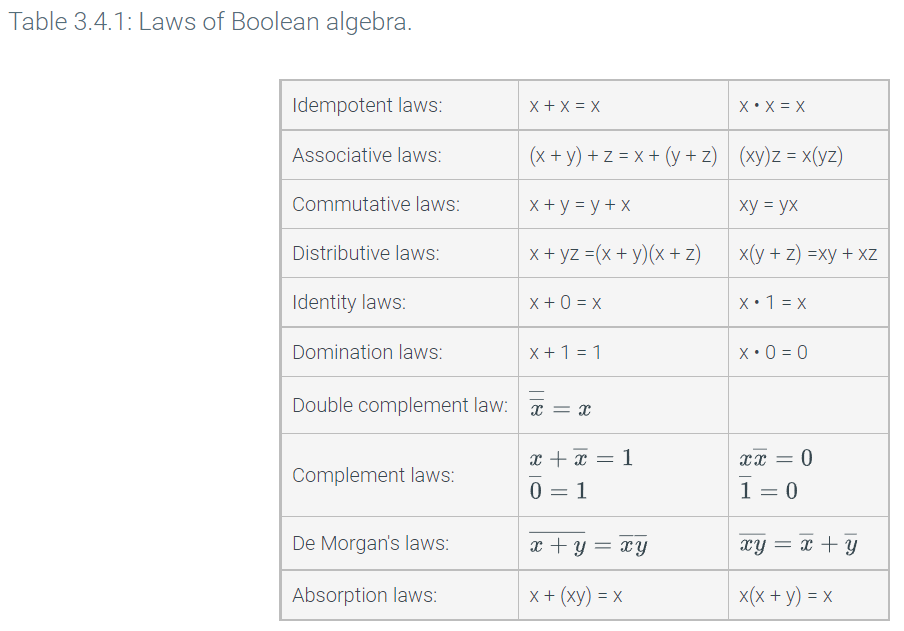
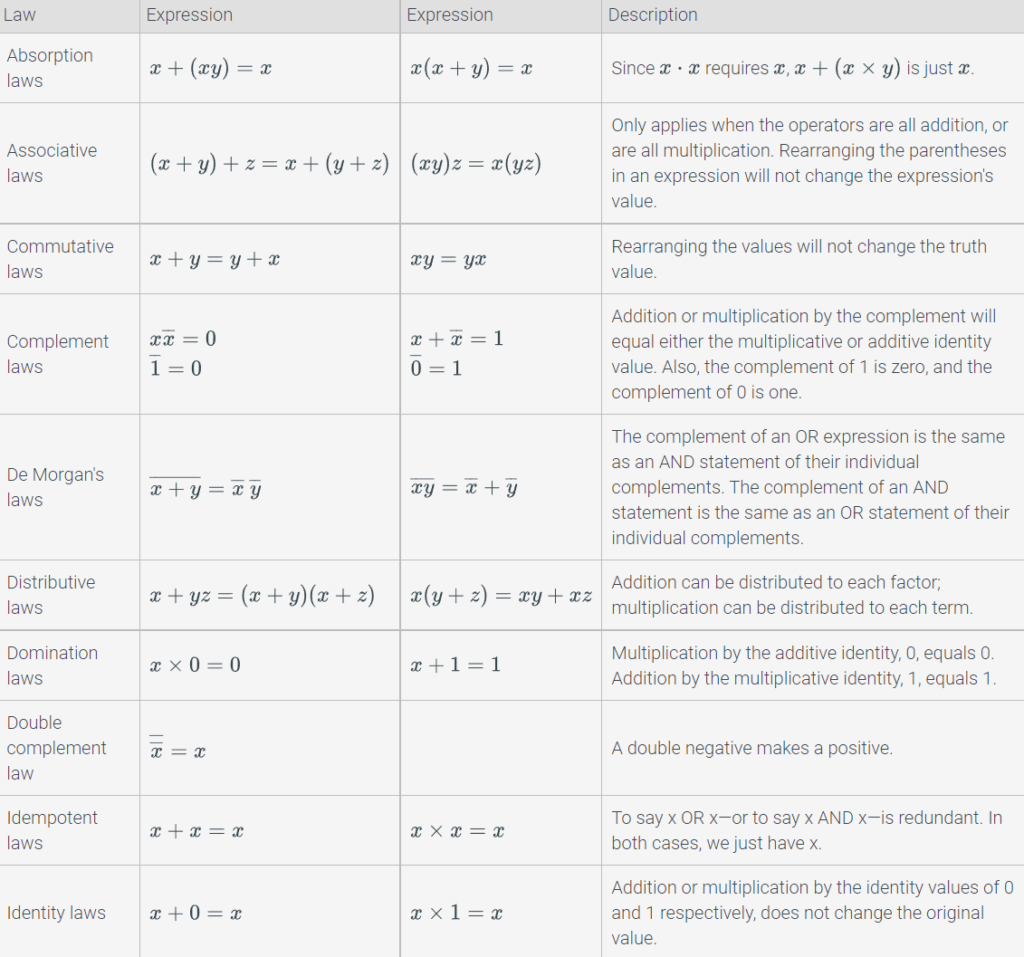
- Make sure you are comfortable with (and can easily list) the following Boolean algebra laws to show equivalence and simplify expressions:
3.5 Lesson: Boolean functions