Now that you have completed this lesson you should be able to determine the power set in a given set. Take a moment to think about what you’ve learned in this lesson:
- The power set of a set A is denoted P(A)
- The power set of any set A is the set of all subsets of A, including the empty set and A itself.
- The empty set is an element of every power set.
- The cardinality of the power set of a set of size n is 2n
2.7 Lesson: Set operations
- Let A and B be sets. The intersection of A and B, denoted A ∩ B and read “A intersect B”, is the set of all elements that are elements of both A and B.
- The union of two sets, A and B, denoted A ∪ B and read “A union B”, is the set of all elements that are elements of A or B. The definition for union uses the inclusive or, meaning that if an element is an element of both A and B, then it is also an element of A ∪ B.
Now that you have completed this lesson you should be able to analyze sets using the intersection and union set operations. Take a moment to think about what you’ve learned in this lesson:
- The union of two sets: A∪B = {x|x∈A or x∈B}. For example, if A = {1,3,5}, B = {3,4,5} then A∪B = {1,3,4,5}
- The intersection of two sets: A∩B = {x|x∈A and x∈B}. For example, if A = {1,3,5}, B = {3,4,5} then A∩B = {3,5}
- The union and intersection operations are commutative. That is, A∪B=B∪A and A∩B=B∩A
2.8 Lesson: Sets with multiple operations


2.9 Lesson: Set difference and symmetric difference
- The difference between two sets A and B, denoted A – B, is the set of elements that are in A but not in B. The difference operation is illustrated in the animation below.
- The symmetric difference between two sets, A and B, denoted A ⊕ B, is the set of elements that are a member of exactly one of A and B, but not both.
- The complement of a set A, denoted A, is the set of all elements in U that are not elements of A. An alternative definition of A is U – A.
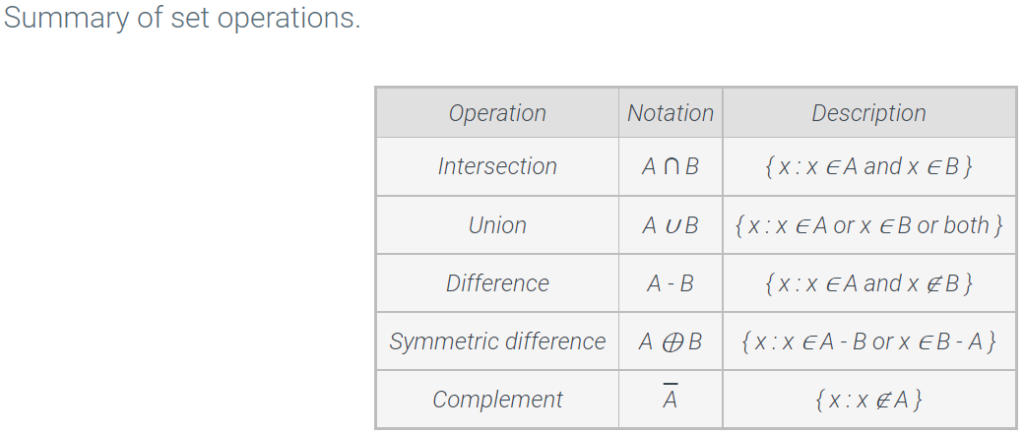
- The difference between two sets A,B is: A – B = {x∈A and x∉B}. For example, A = {1,3,4,5}, B = {4,5,6,7,9} then A – B = {1,3}
- The symmetric difference between two sets A, B is A⊕B = (A – B)∪(B – A)
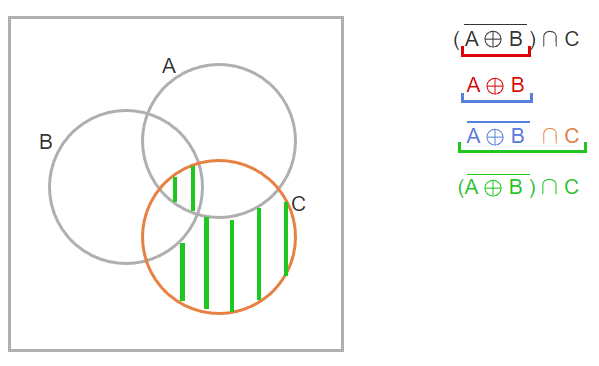
- Using Venn diagrams is a good way to represent multiple set operations.
- The difference operator is not commutative. That is, A – B ≠ B – A
2.10 Lesson: Combining sets
- In order to talk about the complement of a set, there must be an understood universal set. For example, the complement of the set of all even integers with a universal set equal to the set of all integers, is the set of all negative integers.
- The complement of the set A is denoted A. The following expression is the complement of set A: A = {x∈U|x∉A}.
- The union, intersection, and difference operations can be combined in any sequence within an expression. To solve the expression, apply the operations inside each set of parentheses first. For example, (A⊕B)∪(A∩C)
2.11 Lesson: Set identities and laws
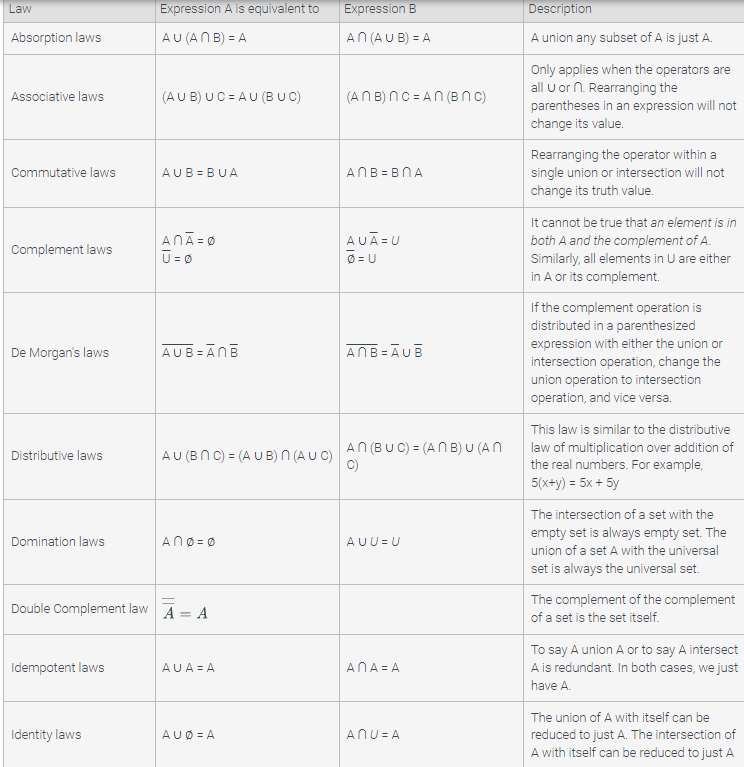
- A set identity is an equation involving sets that is true regardless of the contents of the sets in the expression
- A set identity is an equation that involves sets that are true for all sets. For example, A∪B = B∪A for all sets A,B