2.1 Unit 2: Sets and Functions
The material in this unit comprises 10% of the high-stakes assessment and includes such concepts as:
- Sets, subsets, and power sets
- Set operations
- Cartesian product of sets
- Set partitions
- Overview of functions
- Function properties
2.2 Module 6: Working with Sets
This page marks the beginning of Module 6. This module contains ten lessons:
- Set theory and terms
- Universal sets and subsets
- Set of sets
- Power sets
- Set operations
- Sets with multiple operations
- Set difference and symmetric difference
- Combining sets
- Set identity and laws
- Applying set identity laws
MODULE OBJECTIVE: By the end of this module, you should be able to analyze sets and set operations, including subsets, power sets, set cardinality, and set identities.
2.3 Lesson: Set theory and terms
- A set is a collection of objects. Objects may be of various types, such as titles of books, names of bridges, or rational numbers.
- The objects in a set are called elements.
- The symbol ∈ is used to indicate that an element is in a set, as in 2 ∈ A
- The symbol ∉ indicates that an element is not in a set, as in 5 ∉ A
- The set with no elements is called the empty set and is denoted by the symbol ∅
- The empty set is sometimes referred to as the null set and can also be denoted by {}
- A finite set has a finite number of elements.
- An infinite set has an infinite number of elements.
- The cardinality of a finite set A, denoted by |A|, is the number of elements in A
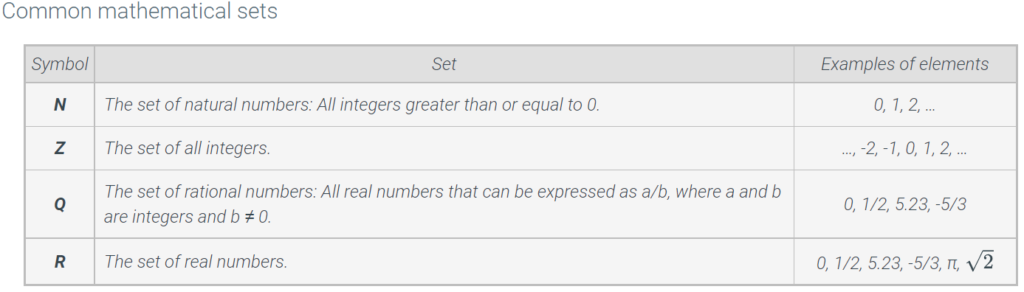
- For example, the set R+ is the set of all positive real numbers, and Z+ is the set of all positive integers.
- A number x is positive if x > 0.
- For example, the set R– is the set of all negative real numbers, and Z– is the set of all negative integers.
- A number x is negative if x < 0. The number 0 is neither positive nor negative, so 0 ∉ Z+ and 0 ∉ Z–.
- A number x is non-negative if x ≥ 0
- In set builder notation, a set is defined by specifying that the set includes all elements in a larger set that also satisfy certain conditions
- The colon symbol “:” is read “such that”.
- A = { x ∈ S : P(x) }
- The description for A above would read: “all x in S such that P(x)”.
Now that you have completed this lesson you should be able to find the set membership and cardinality from a set expressed in set builder notation. Take a moment to think about what you’ve learned in this lesson:
- A set is a collection of objects. The objects of a set are called elements. If x is an element in a set A, it is denoted x∈A
- A set can contain any type of object. It can contain a finite number of elements or infinitely many.
- A set that contains no elements is called the empty set or the null set and is denoted ∅
- Set builder notation is a way to represent a set. For example, the set of all real numbers bigger than 3 can be expressed as {x∈R|x>3}
- When describing a set of elements, it is expressed in context to a superset called the “universal set.” For example, {x∈R|x≥3} refers to the universal set of all real numbers. The bar notation | means “such that”, so {x∈R|x≥3} refers all real numbers greater than or equal to 3.
2.4 Lesson: Universal sets and subsets
- The universal set, usually denoted by the variable U, is a set that contains all elements mentioned in a particular context.
- Sets are often represented pictorially with Venn diagrams.
- If every element in A is also an element of B, then A is a subset of B, denoted as A ⊆ B If there is an element of A that is not an element of B, then A is not a subset of B, denoted as A ⊈ B.
- If A ⊆ B and there is an element of B that is not an element of A (i.e., A ≠ B), then A is a proper subset of B, denoted as A ⊂ B.Venn diagrams are particularly useful for visualizing subset relationships between sets.
2.5 Lesson: Set of sets
Lesson summary
Now that you have completed this lesson you should be able to analyze sets of sets for membership. Take a moment to think about what you’ve learned in this lesson:
- The following is the answer to the question posed in the introduction: If S is in S then it cannot be a member of S by definition of being in S.
- Sets can contain sets as elements.
- The cardinality of a set within a set is 1. That is, each set counts as a single element.